


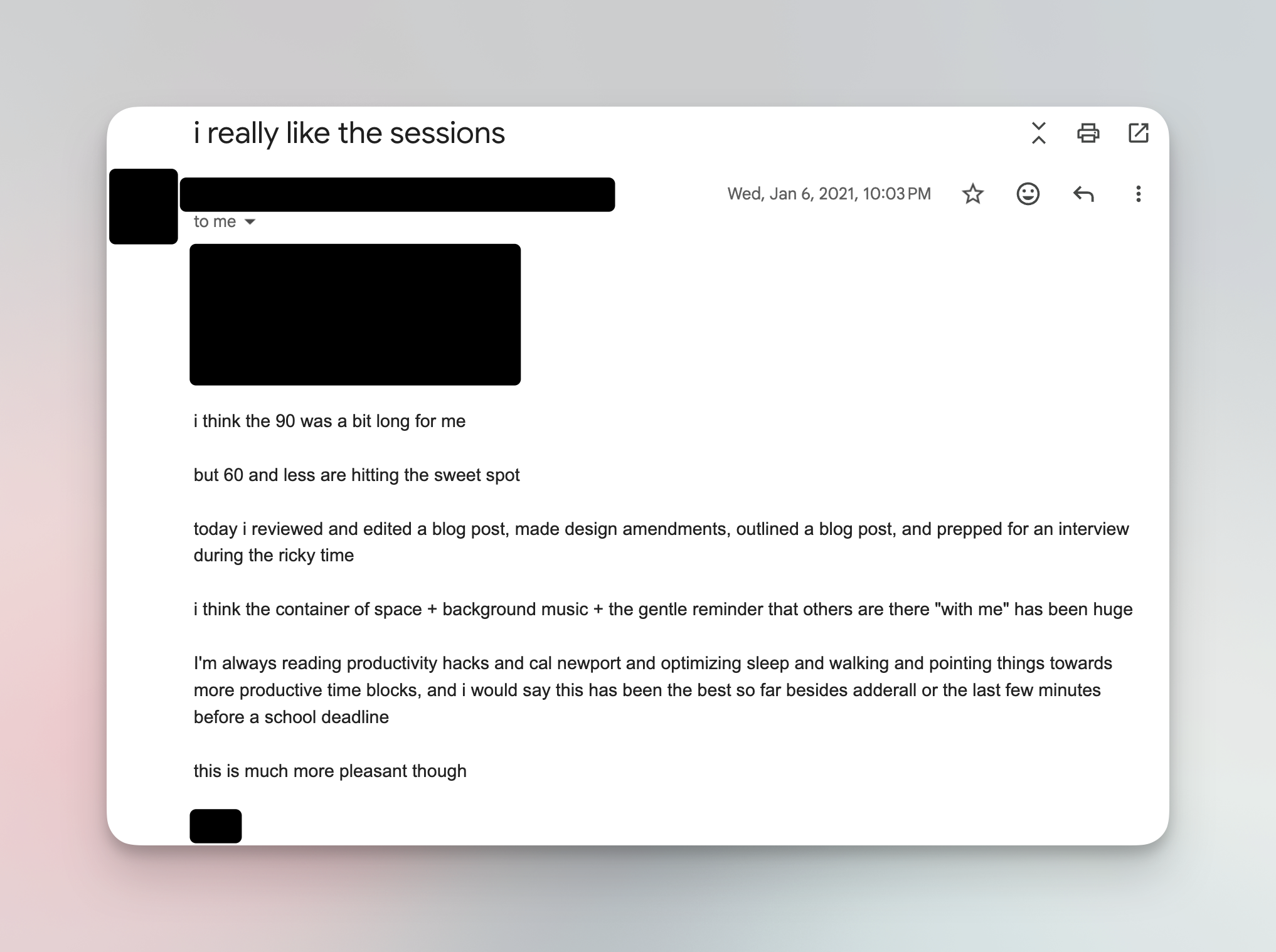
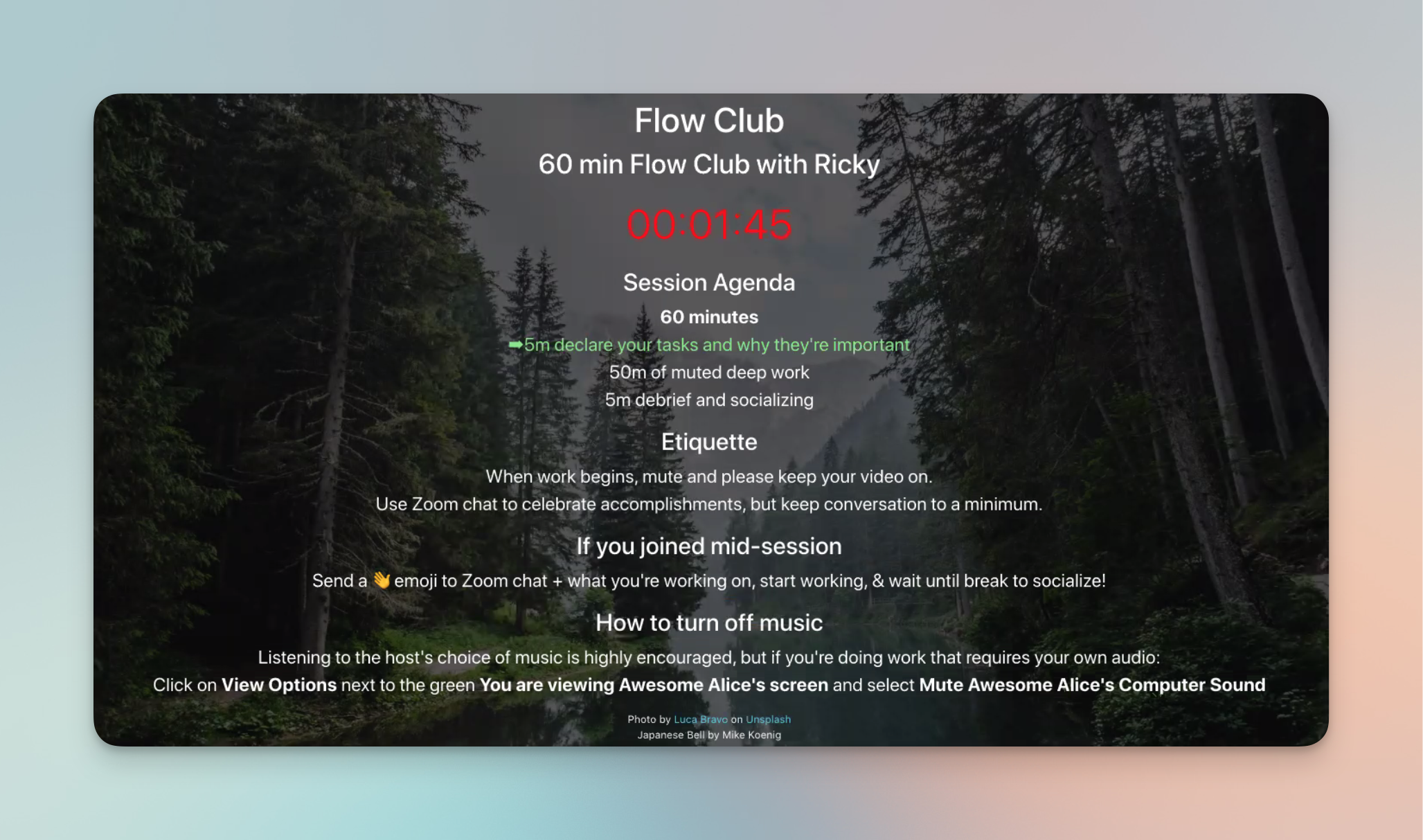
Flow Club sessions are led by community members we call hosts, and capped at 9 people. Every session is time-bound, with duration from 30 minutes to 3 hours. A session opens with each person briefly sharing what they’re going to work on and closes by celebrating incremental progress. Session time is dedicated to coworking quietly alongside one another to create the focusing and calming effect known as “body doubling.” Members bring all kinds of personal and professional tasks to complete, so it’s important that Flow Club is a judgment-free, advice-free, and boundary-respecting community with strong rules and norms.
While there is no definitive way to body double or cowork virtually, we believe Flow Club offers the most effective approach because the format is the result of continuous improvement based on the feedback of our members after 400,000+ body doubling sessions.
I’m Ricky, one of Flow Club’s co-founders. Let me tell you the backstory of how Flow Club’s structure, format, and norms came about.
How did Flow Club start?
In 2020, David and I were building something new together, stuck at home like everyone else. We started coworking over video to stay productive, but I’d always end up talking too much on these calls and distract David from what he was trying to do. So David decided to set some ground rules, put a timer on the screen, and made me promise to stay quiet until the break. We both ended up getting way more done than we would’ve on our own.
As the pandemic raged on, our coworking ritual gave us productivity superpowers. We built ten different products in ten months. By early 2021, we started inviting friends to cowork with us. That’s when everything changed. Our friends invited their friends, and strangers took the time to share with us how transformative the simple arrangement was. They weren’t just saying how much they got done, but how good it made them feel. It felt like we discovered something the world was missing but didn’t have the words for. “Flow” came closest and it felt like a club, so we called it Flow Club. We learned later that this arrangement already had a name in the ADHD community: body doubling.
Building Flow Club is different from building just another app or website because it’s fundamentally a human experience. Human experiences are magical when done well, but can easily disappoint. Our challenge was to understand and capture the magic, and deliver it reliably, every single time.
So we wrote very little code. We didn’t want to be prescriptive about how people get things done. Instead, we’d let behavior emerge before analyzing, debating, and deciding to build software to support it.
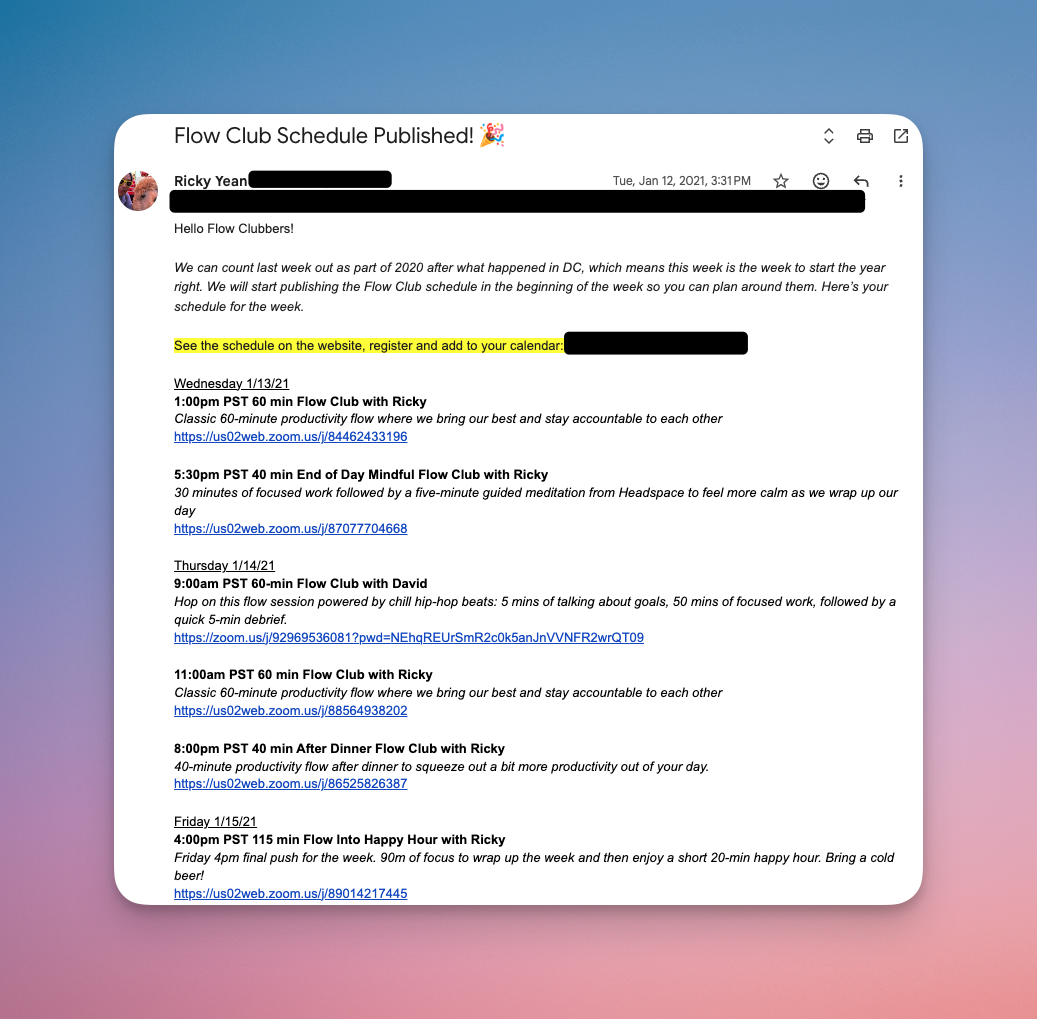
The first version of Flow Club was simply an email to our friends when David and I would be hosting coworking sessions.
Why groups instead of one-on-one?
tldr: Absentee body doubles can be demotivating. Flow Club operates in small groups so sessions stay effective even if a few people don’t show.
Early on when the email list was small, sometimes nobody showed up to my sessions and I’d feel let down.
Of course, people miss commitments and life gets in the way. But because I had set aside the time and worked myself up to it, an empty room took the wind out of my sails.
As our community grew, absentee body doubles became the single biggest complaint. They turned eager anticipation into disappointment, and could easily ruin someone’s day. That’s the messy part of the human experience we needed to address.
It became one of our core principles to make sure when someone commits to a session, they will always find body doubles who match their commitment. One-on-one became too fragile, so we turned to small groups. A few people can be absent or late and the session stays effective for everyone else.

On the importance of showing up for your body double
In our interview with Linda Anderson, MA, MCC, SCAC, and the originator of the term body doubling, she put her finger on why an absent body double is so detrimental. For her, a body double is a counterweight. "It's like the energy is balancing between the two of you," she told me. "It's getting down to a certain level of comfort where you can work." And that balance only exists because both people opted in: "When you've got two people involved, it's a mutual intention." An empty room doesn't just lack a person. It breaks the intention you showed up carrying.
Why cap sessions at 9 people?
tldr: Nine is the largest room where a host can comfortably greet everyone by name and hear what each person is about to work on. For a participant, nine is big enough that you’re not on the spot, but small enough that you’re not invisible.
As word spread about Flow Club, we started seeing 5, 10, 15, 20, even 25 people in a session. Somewhere along the way, the magic disappeared.
Hosts told us they couldn’t manage the clock and still check in with each person. Participants told us the goal-sharing dragged, or that they’d be skipped over entirely.
Then there were the newcomers who were feeling anxious the way anyone is the first time they try something. When a session was too small, they found it uncomfortable. “It’s like I’m being watched,” they’d tell us. When a session was too big, they’d say it hadn’t done anything for them, only for us to find out later that they had hidden themselves and avoided interacting with anyone. Nine is where both problems disappear.
Who leads Flow Club sessions?
tldr: Members do. We call them hosts. They are peers, not coaches or instructors. They open the session, run the check-in, and work alongside you on their own tasks.
David and I were the original hosts. At one point, I was hosting 25 sessions a week and the number one request we got was still “more sessions.” People needed to get things done at all hours, and not just on our schedule. That made sense. What surprised us was what happened next: members volunteered to host.
We had considered hiring facilitators, but it never sat right. People come to Flow Club with wildly different work and life tasks, and their own private sense of what time well spent looks like. Nobody could coach that without really knowing them.
The bigger problem was how paid facilitators would upset the dynamic. It would instantly create a supervisory relationship, which runs counter to everything members told us they loved about Flow Club – the empowered feeling that they were doing this themselves, in good company.
We started inviting Flow Clubbers to lead sessions, and they took to it immediately. Holding space for others turns out to be its own reward, and it makes you more productive too, because you end up leading by example. Having thousands of hosts made Flow Club more vibrant and relatable. There is likely to be someone else who shares your struggle, and can mirror for you how you can overcome it.
Most importantly, hosting shaped Flow Club’s culture. Peers taking turns hosting made Flow Club feel communal. It became easy to root for each other’s success because “we are in it together.” Since hosts are volunteers, it became customary to always thank the host for hosting, and gratitude permeated the space. We are grateful for each other’s presence because we are buoyed by it. We are grateful for the time we have. We are grateful to ourselves for choosing to show up intentionally.
Body doubling was intended to be a peer relationship
Linda Anderson, who coined the term body doubling, put it plainly when I asked what makes a good body double: "They're not there to supervise you, they're not your coach." Her 1996 article explains why — "it requires energy to instruct, supervise, or be interrupted by another person, and that expenditure of energy equates to distraction." What she wants instead is "a mirror, but a quiet one, not a judgmental one," which is as good a description of a Flow Club host as we've ever written.
How does Flow Club improve on its approach?
tldr: Constantly. We see Flow Club as an ongoing project in building the best environment to support human flourishing.
Flow Club continues to be shaped by our members.
We watched members join back-to-back-to-back sessions, so we added longer sessions. At the same time, others were sharing with us that even an hour of focus is hard to sustain, so we added 30-minute sessions and Pomodoro-style sessions with more frequent breaks.
As 30-minute sessions proliferated, we learned that the 9-person limit was too high. Members told us check-ins were taking too long for just a half-hour of work, so we reduced it to 5.
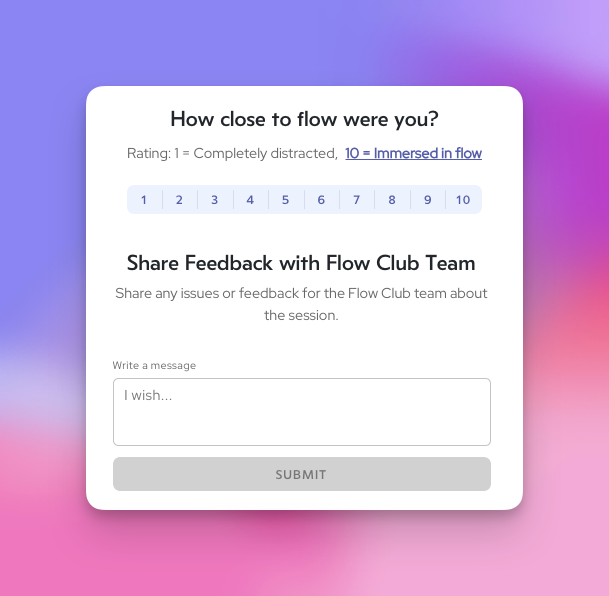
When introverts and ADHDers found the platform, we’d hear feedback about having “low social energy” or “limited spoons,” so we introduced “chat-only” non-verbal sessions.
We continue to test new formats, remove ineffective ones, while keeping the overall experience simple. We believe technology is at its best when it’s invisible. Flow Club is here to highlight the best humanity can offer each other.
Your invitation to try Flow Club
If you’ve read this far, you’re the kind of person we built Flow Club for. We’d love to invite you to join a Flow Club session and tell us how you feel after.

.jpg)


